Travel Tips: How to Keep Moving When You Are Away From Home
Going Somewhere This Summer? Your Body Is Coming With You. Every July, a good portion of the Lake Chapala community heads out — back to the US or Canada, a family visit, a long-awaited trip. And every August, some of them come back feeling worse than when they left.
7/10/20263 min read

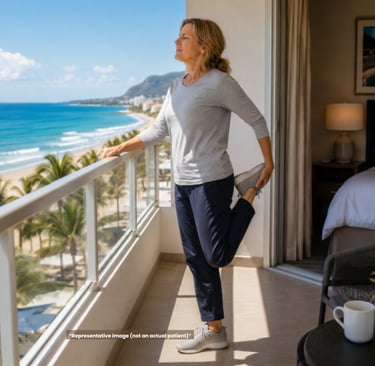
Every July, a good portion of the Lake Chapala community heads out — back to the US or Canada, a family visit, a long-awaited trip. And every August, some of them come back feeling worse than when they left.
Not because travel is bad for you. But because most people forget that their body still needs the same things on the road that it needs at home. Movement. Rest. A little attention.
This month we want to make sure that if you are traveling — or someone you love is — you have a few simple tools to come home feeling as good as you left.
WHY TRAVEL IS HARDER ON THE BODY THAN IT LOOKS
A long flight or a full day of driving asks your body to stay still in a compressed position for hours. Circulation slows. Muscles stiffen. The spine, hips, and knees — which are designed to move — spend the journey doing the opposite.
Add a time zone change, disrupted sleep, and meals that do not match your usual routine, and the body has a lot to manage before you even arrive.
For people managing arthritis, recovering from surgery, or working through a physical therapy program, this is not just discomfort. It can set progress back in ways that take weeks to recover.
The good news is that a few small habits make an enormous difference.
THE STRANGE BED PROBLEM
Almost everyone notices it. You sleep in an unfamiliar bed and wake up stiff in places that do not normally bother you. A mattress that is too soft, a pillow that is too flat, a sleeping position you would never choose at home — and your back, neck, or hips remind you all morning.
A few things that help:
Request a firm mattress when booking if that is what works for you. Many hotels will accommodate this.
Travel with your own pillow if you can. It sounds indulgent. It is actually practical.
Sleep with a small rolled towel or travel pillow under your knees if you are a back sleeper, or between your knees if you sleep on your side. This takes pressure off the lower back and hips in ways that matter, especially on unfamiliar surfaces.
Give yourself ten minutes in the morning before you get up. Gentle movement in bed — ankle circles, knee bends, slow shoulder rolls — warms the body up before you ask it to stand and start the day. This is especially important when you are away from your usual morning routine.
KEEPING UP WITH YOUR PT EXERCISES ON THE ROAD
This is the one Oscar hears about most when patients return from a trip. They stopped doing their exercises. Not because they did not want to — but because the routine was gone, the space felt wrong, and it was easy to tell themselves they would catch up when they got home.
Here is the reality: most PT exercises require no equipment and very little space. A hotel room floor is enough.
Before you travel, ask Oscar or your therapist to give you a short travel version of your program. Five to eight minutes, no equipment, the most essential movements. Write it down or take a photo of it. That is your travel routine.
Do it in the morning before you leave the room. Not after breakfast, not when you get back in the evening — because those moments have a way of disappearing. Morning, before the day starts, is the only time that reliably holds.
If you miss a day, start again the next morning. One missed day is not a setback. A week of missed days is harder to recover from.
ON THE PLANE OR IN THE CAR
Get up and move every hour on a long flight. Walk to the back of the plane, do a few calf raises in the aisle, roll your ankles. It feels slightly awkward and it matters significantly for circulation.
In the car, stop every ninety minutes to an hour. Get out, walk for five minutes, stretch your hip flexors briefly before getting back in. The delay costs almost nothing. The stiffness you avoid is worth it.
Stay hydrated. This is always true, but travel makes it easier to forget. Dehydrated joints and muscles are less resilient and more prone to stiffness and pain.
A CLOSING WORD FROM OSCAR
Travel is one of the great pleasures of life, and I never want a patient to feel like their body is the reason they cannot enjoy it. But I do want you to take your body with you intentionally. A few minutes of movement each day, a little attention to how you are sleeping, and a short version of your exercises — that is all it takes to come home feeling like yourself. If you are heading out this summer, safe travels. And if you want to put together a simple travel program before you go, come see us.
DISCLAIMER
Aways consult a qualified healthcare professional before diagnosing yourself or starting a new health routine. Every situation is unique and personalized guidance matters.
SOURCES
Mayo Clinic — Tips for Traveling with Arthritis
https://www.mayoclinic.org/healthy-lifestyle/adult-health/in-depth/arthritis/art-20047971
Cleveland Clinic — How to Prevent Back Pain While Travelinghttps://health.clevelandclinic.org/how-to-prevent-back-pain-while-traveling
NIH National Institute on Aging — Exercise and Physical Activity
https://www.nia.nih.gov/health/exercise-physical-activity
NHS — How to Prevent Deep Vein Thrombosis on Long Journeys
https://www.nhs.uk/conditions/deep-vein-thrombosis-dvt/prevention


Contact Information:
Phone: +52 1 222 442 1136 (Whatsapp)
Service Area: North Shore of Lake Chapala, Jalisco
Website by Leissa Gebert | Next Chapter Consulting
@2026 All Rights Reserved
The information on this website is meant to help you better understand your health and wellness but should not replace professional care. If you have questions about your specific needs, give us a call—we’d be happy to schedule a consultation and help you on your journey to feeling your best!